
Home/Blog/I Built an Open-Source Agent Skill Kit for Salesforce Revenue Cloud (Here's Why)
Revenue Cloud
I Built an Open-Source Agent Skill Kit for Salesforce Revenue Cloud (Here's Why)
Rohit · May 16, 2026 · 4 min read
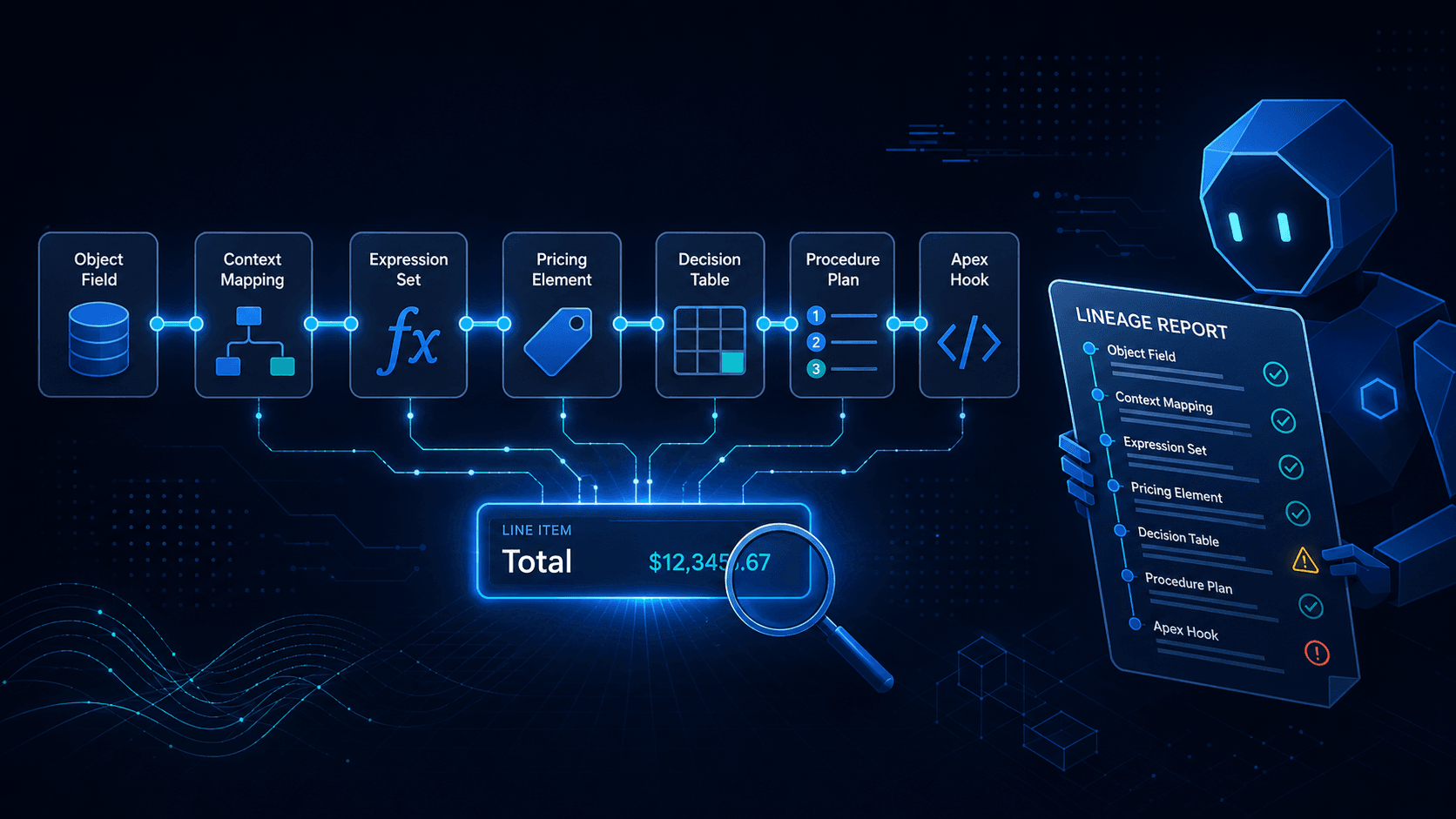
If you work on Salesforce Revenue Cloud, you already know the hardest part is rarely "How does this field get set with a price?"
The hardest part is proving where that number came from.
You're often tracing a single field across:
- object metadata
- context definitions and mappings
- expression set versions
- pricing elements
- decision tables
- procedure plans
- Apex hooks
To make that easier (and repeatable), I created an open-source skill kit called Salesforce Revenue Cloud Skills.
👉 GitHub: salesforce-revenue-cloud-skills
What We Created
We created a multi-skill repository:
- Repo: salesforce-revenue-cloud-skills
- First skill:
revenue-cloud-pricing-diagnostics
This first skill teaches an AI coding agent how to dissect Revenue Cloud pricing logic in a structured way.
It is designed for Revenue Cloud architects, developers, and consultants who need to answer questions like:
- "How is this Quote field populated?"
- "Which expression set step is setting this value?"
- "Which decision table row is being matched at runtime?"
- "Why does UI pricing work but API pricing fail?"
Why This Skill Is Useful
Revenue Cloud pricing logic is distributed across metadata and runtime APIs.
Without a guided method, troubleshooting becomes ad-hoc and slow.
This skill provides a default workflow so agents can consistently trace pricing lineage from end to end, instead of guessing.
It also explicitly separates Revenue Cloud from CPQ assumptions:
- ✅ Revenue Cloud core model (context-driven)
- ❌ Steelbrick CPQ (
SBQQ__*) model
When You Should Use This Skill
Use revenue-cloud-pricing-diagnostics when you need to:
- trace how a field is populated
- understand pricing impact on Quote/Order/Line fields
- debug expression set behavior
- analyze context mapping hydration/persistence issues
- inspect decision table lookup mismatches
- investigate procedure plan sequence and Apex pre-hook dependencies
- compare UI vs API pricing outcomes
How It Works
The skill uses a practical metadata-first and runtime-verified approach:
- Find the object field metadata in SFDX source.
- Map that field to context attributes and tags.
- Follow context mappings for hydration/persistence.
- Trace expression set variables and steps.
- Inspect pricing elements and decision tables.
- Validate runtime decision-table behavior using the Business Rules Engine Connect API.
- Correlate with procedure-plan sequence and Apex hooks.
- Produce a structured lineage report with evidence and failure points.
What's Included in the Skill
Inside the skill folder you'll find:
SKILL.md(core instructions and default workflow)- references for:
- architecture
- field-lineage workflow
- procedure plans
- pricing elements and decision tables
- troubleshooting
- eval scenarios for testing skill quality
This keeps it maintainable and allows more skills to be added over time.
How To Use It
After installing the skill in your project skill directory, ask natural-language prompts like:
- "Help me understand how
Quote.RCA_TotalMRRAmount__cis populated." - "Trace this pricing field from object metadata through context mapping and expression sets."
- "Why does Place Sales Transaction return
DUPLICATE_VALUE_FOUND_IN_LOOKUPwhile UI pricing succeeds?" - "Which procedure plan section writes this final total?"
The agent is guided to return a concise lineage report with technical evidence.
Decision Table Debugging (Big Win)
A major addition is practical guidance for real decision-table runtime checks:
-
query
DecisionTablerecords (Id, DeveloperName, Status, SourceObject, etc.) -
locate dataset links
-
invoke lookup via Connect API:
/services/data/vXX.X/connect/business-rules/decision-table/lookup/{decisionTableId} -
compare runtime condition inputs against expression-set expectations
This helps bridge the gap between "metadata says this should work" and "runtime did something else."
Who This Is For
- Salesforce Revenue Cloud architects
- Revenue Cloud implementation consultants
- Salesforce developers and technical leads
- Teams standardizing pricing diagnostics across orgs
Open Source and Contributions
This project is open source (MIT licensed), and the goal is to grow it into a broader Revenue Cloud skills library.
If you've built repeatable diagnostics for renewals, assetization, subscription pricing, or lifecycle issues, contributions are welcome.
👉 Repo: salesforce-revenue-cloud-skills